


Living in one’s own house is a strongly rooted idea in Slovakia. But is living in your own home really automatically a rational choice? Or is it rather a cultural setting that we do not economically calculate? In Peter Varga’s lecture on real estate, we looked at this question without emotion, through numbers, liquidity, tax implications and the broader context of investing in Slovakia.
In the model example, we work with a property worth 1.5 million euros, own resources of 500,000 euros and financing of 1 million euros with a mortgage. The comparable rent is EUR 4 500 per month. We consider the alternative capital appreciation conservatively at 3% per annum.
In order to make the purchase mathematically worthwhile in this setting over a five-year horizon, the value of the property would have to grow by approximately 2.7% per annum.
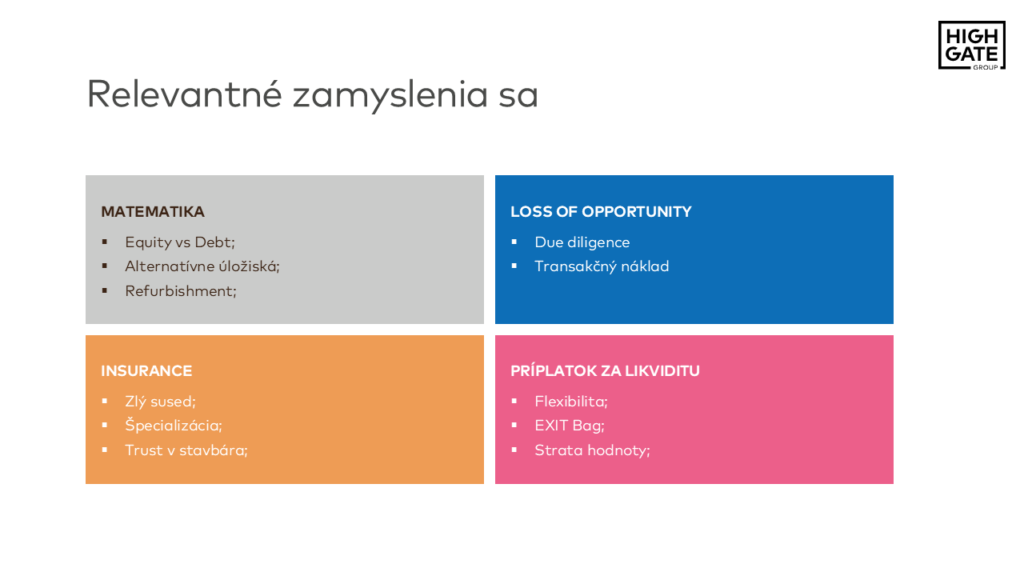
This is the key moment. The decision is not just about “rent is money wasted”. It is about comparing two models of working with capital. In one, we tie up capital in an illiquid asset. In the other, we retain flexibility and allocate capital elsewhere.
In addition, we often do not take into account:
Pure mathematics captures only part of reality.
The first factor that we don’t get into Excel is liquidity. Real estate is an inherently illiquid asset. At the higher end, the time to sell can be several years. Yet liquidity has a standalone value in times of uncertainty.
The second factor is flexibility. The lease makes it relatively easy to exit and adapt to a change in living or business situation. Ownership implies commitment.
The third factor is the so-called loss of opportunity. The time that an investor spends on property selection, technical condition or contract documentation is time that cannot be devoted to his primary expertise. And that can be worth more than the difference between rent and mortgage alone.
Petr Varga’s lecture was not only about housing. It was also about how the Slovak tax system distorts investment decision-making.
In Slovakia we have:
The state declares tax neutrality and support for long-term savings. In practice, however, the different regimes lead to the investor deciding not on the economics of the project, but on tax optimisation.
Therefore, the decision between buying and renting is, in the broader context, a question of capital allocation, risk and the legal environment.
The purchase can be rational if the investor:
Rent can be rational if it is a priority:
The decision should not be the result of a cultural stereotype, but a conscious comparison of models.
We are the Highgate Group, modern advisors for your law, tax and accounting under one roof.
If you are interested in similar analysis on investing, capital markets and taxation, subscribe to our newsletter and follow our content.
Do not hesitate to contact us:
Alternatively, you can address your specific questions in a consultation with our partner Peter Varga, who specialises in financial regulation and tax law. You can book a consultation here: