

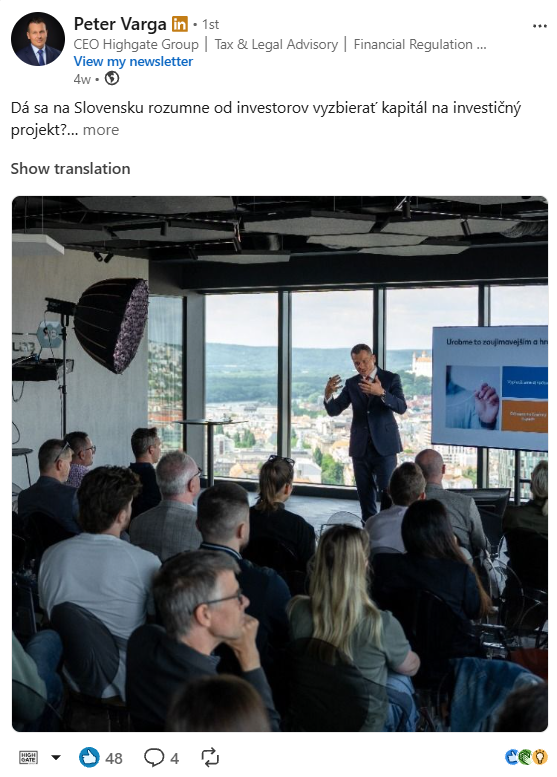
Is it reasonable to raise capital from investors in Slovakia for an investment project?
One way to do this is through endowments.
Please note: If you meet the criteria for collective investment and do not have a “license,” you face not only a fine but also, as a standard procedure, a referral to law enforcement authorities. Although unauthorized business operations carry a low penalty, they also constitute a predicate offense for the laundering of proceeds from criminal activity.
But not every fundraising effort is a “regulated” fund. For example:
🔹 There are exceptions to the regulations, and if you qualify for them, you don’t need a regulated or “regulated” fund;
🔹 Bonds that offer significant regulatory and tax arbitrage (I discussed this in more detail, for example, in a presentation for the Slovak Association of Asset Management Companies—link to the presentation in the comments)
🔹 Crowdfunding
🔹 IPO, ITO, …
So when does Slovakia make sense? More often than you’d expect.
For example, a Slovak SICAV is cheaper and more practical than a Czech one for many structures. And in some cases, it’s also more tax-advantageous. Not because we have “a 5% tax rate like the Czechs do,” but, for example, because dividends are still not taxed in Slovakia.
And there are more structures like this. But, unfortunately, this isn’t because the government deserves credit for its purposeful public policy—it’s because we have to be super creative.
All of this is aimed at improving the standard of living in Slovakia.
Because the goal is not:
🔹 so that added value flows into Slovakia, but
🔹 so that added value does not flow out of Slovakia.
Modestly.
For those interested in exploring this topic further, I recommend our latest Highgate Group podcast with Tomáš Demo and Roman Baranec (link in the comments), or our conference “Why and How to Stay in Slovakia,” on November 25, where we aim to show—in a pragmatic, not sentimental way—where Slovakia still makes sense (link in the comments).