
Domov > Tax-tax calculator for 2026

Tax-tax calculator for 2026

What is it for

These forms are used to provide an indicative comparison of the net income for 2026 of a self-employed entrepreneur (e.g. sole trader) vs a “one-person” SRO. As the tax and tax system in Slovakia is relatively complex, we have abstracted from some elements with less significant impact in order to make the calculator user-friendly and practical.

How the calculator works

  1. Choose one of the basic options Limited liability company or Self-employed.
  2. Choose one of the two scenarios.
  3. Fill in the required and optional fields.
  4. Use the Calculate button.
  5. Once the calculations have been run, you will see the results and in particular the Net Income of the entrepreneur (for SROs it also takes into account the minimum insurance premium and the remuneration of the statutory officer).

Other aspects (e.g. other income, legal liability, social security benefits) also influence the choice for a better legal form of business. If you have questions, we will be happy to answer them.


Prerequisites and reservations

  • The table is intended as an indicative comparison of business opportunities and does not constitute legal or tax advice in relation to a specific user.
  • The table abstracts from the child tax credit and the tax credit for interest paid, as their amounts depend on other parameters that need to be analysed individually.
  • The calculations for the self-employed (e.g. sole trader) are abstracted from the so-called micro-deduction for social security contributions, which was introduced from 2026.
  • The calculations for a self-employed person (e.g. a sole trader) apply provided that the self-employed person starts his/her business in 2026 and applies flat-rate expenses according to § 6 (10) of Act No. 595/2003 Coll. on income tax.
  • Tax costs/expenses are the same as total costs/expenses. In some cases it is difficult to determine whether it is a tax cost/expense or not (e.g. luxury watches as a tax expense).
  • The calculations do not take into account the amortisation of tax losses of previous years or the amortisation of the minimum tax.
  • The entrepreneur is not a disabled person.
  • The entrepreneur is resident for tax, social security and health insurance purposes in Slovakia.
  • The calculations for a self-employed person (e.g. a sole trader) apply assuming that the self-employed person does not also receive income from employment.
  • The calculations for SROs are valid provided that the remuneration of the statutory body does not exceed EUR 600/month.

What is it for

These forms are for an indicative comparison of the net income for 2025 of a self-employed entrepreneur (e.g. sole trader) vs a “one-person” SRO. As the tax and taxation system in Slovakia is relatively complex, we have abstracted from some elements with less significant impact in order to make the calculator user-friendly and practical.

How the calculator works

  1. Choose one of the basic options Limited liability company or Self-employed.
  2. Choose one of the two scenarios.
  3. Fill in the required and optional fields.
  4. Use the Calculate button.
  5. Once the calculations have been run, you will see the results and in particular the Net Income of the entrepreneur.


Other aspects (e.g. other income, legal liability, social security benefits) also influence the choice for a better legal form of business. If you have questions, we will be happy to answer them.


Prerequisites and reservations

  • The table is for indicative comparison of business opportunities and does not constitute legal or tax advice in relation to a specific user.
  • The table abstracts from the child tax credit and the tax credit for interest paid, as their amounts depend on other parameters that need to be analysed individually.
  • The calculations for a self-employed person (e.g. a sole trader) apply provided that the self-employed person starts his/her business in 2025 and claims lump-sum expenses according to § 6 (10) of Act No. 595/2003 Coll. on income tax.
  • Tax costs/expenses are the same as total costs/expenses. In some cases it is difficult to determine whether it is a tax cost/expense or not (e.g. luxury watches as a tax expense).
  • The calculations do not take into account the amortisation of tax losses of previous years or the amortisation of the minimum tax.
  • The entrepreneur is not a disabled person.
  • The entrepreneur is resident for tax, social security and health insurance purposes in Slovakia.

Tax and levy obligations of self-employed persons and SROs in 2026: a comprehensive overview of current rates and limits

Indicators

In 2026, the amount of the applicable subsistence minimum, which is the basis for a number of tax and levy calculations and indicators, such as the non-taxable parts of the tax base, will change. For 2026, the subsistence minimum is based on EUR 284.13 per month, which represents a slight increase compared to the previous year.

Calculations of taxable earnings and tax “thresholds” are also based on the average wage in the national economy. For 2026, the average wage two years back, so for 2024, which amounted to EUR 1 524, is decisive.

Tax rates

The dividend tax rate is 7%. Care should be taken as to what period the dividends relate to and the correct tax rate should be applied as the tax rate is 10% during 2024.

Legal entities, such as limited companies, will apply four rates for 2026:

  • 10 % – Reduced corporate income tax rate for turnover up to EUR 100 000
  • 21 % – Standard rate
  • 24 % – Increased rate for turnover over EUR 5 000 000
  • 35 % – For special tax bases

CSOs have an advantage over individuals who are not CSOs in the form of a reduced tax rate of 15%. For the self-employed, the following tax rates apply:

  • 15% – if taxable income for the tax period does not exceed EUR 100 000;
  • 19% – in other cases and for a tax base below the threshold of EUR 43 983.32;
  • 25% – in other cases and on the amount exceeding EUR 43 983.32;
  • 30% – in other cases and on the amount exceeding EUR 60 349.21;
  • 35 % in other cases and on the amount exceeding EUR 75 010,32.

Deductions

Employees or executives with earned income will pay the following in 2026:

  • 5% – Health insurance on gross wages/remuneration
  • 2.5% – Health insurance for people with disabilities
  • 9,40 % – Social insurance

Self-employed persons will pay contributions:

  • 4,40 % – Sickness insurance
  • 18 % – Old-age insurance
  • 6 % – Disability insurance
  • 4,75 % – Solidarity Reserve Fund
    • Total: 33,15 %
  • 16 % – Health insurance
  • 8 % – Health insurance for people with disabilities

The minimum taxable amount for contributions of self-employed persons increases to EUR 914.40 from January 2026. The maximum assessment base will reach EUR 16,764 for most social levies. Health levies do not have a cap.

Non-taxable parts of the tax base

The non-taxable part of the tax base (NČZD) per taxpayer increases to EUR 5,966.73 (21 times the applicable minimum subsistence level) in 2026, while its amount decreases with a higher tax base. If the tax base of a sole trader is equal to or higher than EUR 43,983.32 per year, the amount of the non-taxable part of the tax base is EUR 0.00.

A spouse may be eligible for NHT in the amount of:

  • 5 455.30 euros, which is also reduced depending on the tax base, and if the tax base of the sole trader is 60 349.19 euros or more, the NČZD is 0.00 euros.

Taxpayers can still claim a deduction for supplementary pension savings (Pillar III) of up to EUR 180 per year.

Tax bonuses

Fixed tax bonus amounts:

  • EUR 100 per month – Per child up to 15 years
  • 50 euros per month – Per child from 15 to 18 years

However, the amount of the tax bonus may be up to a maximum of the product of the relevant percentage and the taxpayer’s tax base. The individual percentages are as follows:
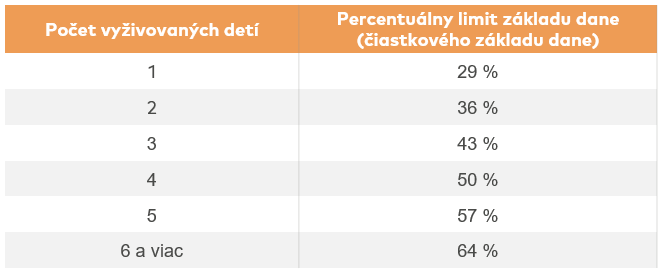
Taxpayers can also benefit from a 50% tax bonus on mortgage interest paid, with a maximum tax bonus of €1,200 per year for contracts signed after 1 January 2024.

Lump-sum expenses and advance income tax payments

Lump-sum expenditure remains at 60% of income in 2026, capped at €20,000 per year.

There are rules for the payment of advance income tax for both corporations and individuals:

  • Quarterly Advances – Mandatory for tax liability exceeding €5,000
  • Monthly advances – Mandatory if the amount exceeds EUR 16,600

Investment portfolios

In the case of an individual or legal entity seeking to capitalise its assets through capital market instruments, the tax legislation is complex and it is not possible to clearly determine the tax liability without further analysis. Examples might be the most advantageous foreign currency to euro conversion for an individual or the application of double taxation treaty provisions. In the case of legal entities and some self-employed persons, proper accounting with an emphasis on the tax implications of individual transactions is necessary. More about investment portfolios

Don’t miss the next LIVE recording of Highgate Talks.