

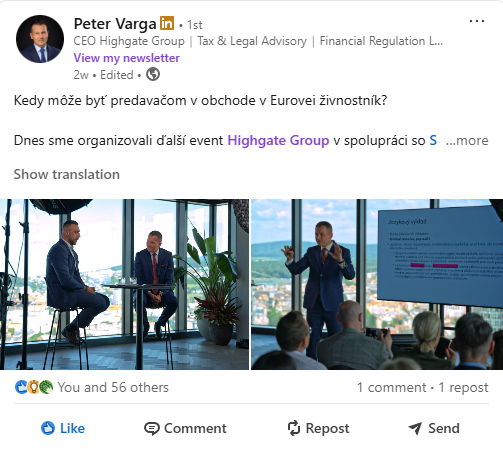
Under what circumstances can a self-employed person work as a sales clerk at a store in Eurovea?
Today we organized another Highgate Group event in collaboration with SLOVCA—the Slovak Venture Capital & Private Equity Association.
In addition to an excellent discussion with Juraj Hajš, director of the Trenčín Labor Inspectorate (watch our Highgate Talks on YouTube—the recording will be posted there), I presented my legal opinion in a separate lecture on the circumstances under which even a sales clerk at Eurovea could be considered a contractor.
I believe that in a critical mass of real-world cases, a linguistic interpretation of the legal provisions governing illegal employment is insufficient.
When analyzing when the Labor Inspectorate has the right to intervene in the contractual freedom of the salesperson and the store at Eurovea, other methods and tools of interpretation must also be taken into account, in particular:
🔹 What values does this regulation protect?
🔹 Subjective historical interpretive objectives of this regulation;
🔹 Long-established practice among attorneys or legislative aides;
🔹 Constitutionally compliant interpretation (prohibition of broad linguistic interpretation, in dubio mitius, in dubio pro libertate, …);
The Švarc system is an interdisciplinary topic. In addition to fines from the labor inspectorate, back payments of advance contributions, and late-payment interest, this topic also addresses, for example, whether the costs of vehicles used by contractors are tax-deductible expenses and whether a business owner is entitled to a VAT deduction.
💡In addition, we are currently seeing a relatively higher number of tax audits.
However, since we are unlikely to see any impetus for reform in the near future, we have no choice but to work and protect entrepreneurs with the resources we have.
💡And this includes this legal argument and our efforts to make Slovakia a better and more predictable place for economic activity. 💡