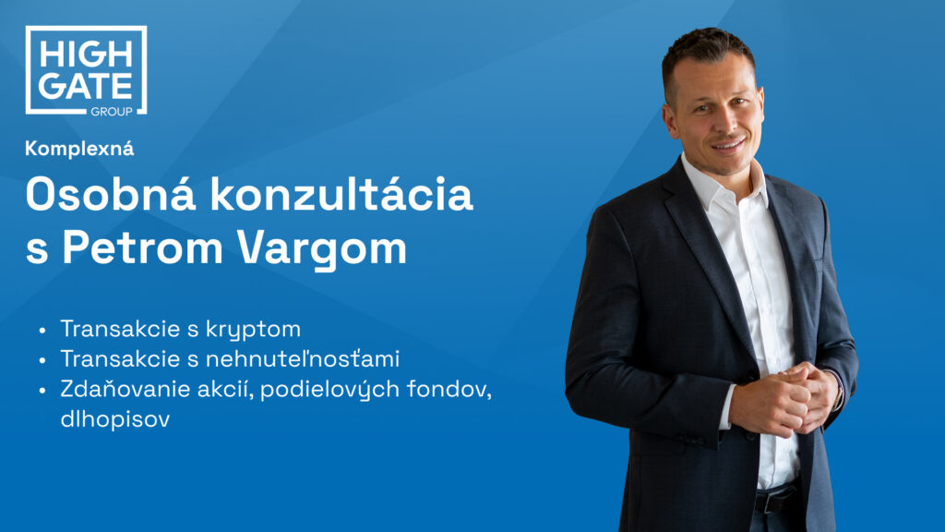

Many investors today are considering whether it still makes sense, from a tax perspective, to invest from Slovakia, or whether it is more advantageous to move their assets or tax residency abroad. However, the answer is not as simple as it might seem at first glance. Peter Varga and Tomáš Demo discussed this topic in Episode #47 of the Highgate Talks podcast, where they discussed not only tax rates but also the broader context of investing, asset protection, and structuring ownership arrangements.
In practice, the tax rate itself is often just one of many variables. Equally important are how the investment is structured, who holds it, what risks an offshore structure entails, and what options Slovak legislation offers.
In public discussions about investing, it is often said that Slovakia is unfavorable from a tax perspective. The reality, however, is significantly more complex. After all, it is not only the tax rates themselves that matter, but also the form of investment ownership, the options for structuring ownership, the administrative burden, and the approach of the tax authorities.
One of the most frequently cited arguments against investing from Slovakia is taxes. In practice, however, many investors overlook the fact that Slovak legislation offers relatively favorable conditions for several types of investments. A typical example is publicly traded stocks. If an individual meets the legal requirements and holds shares traded on a regulated market for more than one year, the income from their sale may be tax-exempt. Similarly, Slovakia is among the countries with relatively favorable dividend taxation.
On the other hand, there are also investments where the tax burden is higher, such as certain types of income from cryptoassets. Even in these cases, however, it is not appropriate to look solely at the tax rate itself. What matters is the overall structure of the investment and the ownership structure.
Peter Varga and Tomáš Demo discussed this topic in more detail in Episode #47 of the Highgate Talks podcast.
One of the most common questions investors ask is whether to invest as an individual or through a company.
The correct answer depends on several factors. The most important ones are the type of investment, the planned investment horizon, the method of generating returns, and whether the investor plans to trade actively or invest for the long term.
When actively trading, a company may enjoy certain advantages, such as when offsetting tax losses or reinvesting profits. Conversely, when holding certain assets for the long term, the rules applicable to individuals may be more advantageous.
Real estate investments must also be evaluated on a case-by-case basis. The circumstances of the specific investment are decisive—whether it involves a long-term lease, a real estate development project, or another form of investment. Each situation has different legal and tax implications.
Cyprus, Luxembourg, Dubai, and other foreign jurisdictions are increasingly common topics of discussion among investors. However, simply establishing a company abroad does not automatically mean lower taxes or greater asset protection.
Modern international rules increasingly require that a foreign company have substantive economic substance, independent management, and a genuine business rationale. Failure to meet these conditions may call into question the expected tax benefit.
That is precisely why, at Highgate Group, we do not focus solely on the tax rate when designing offshore structures. We assess the entire legal, tax, and business context to ensure that the solution is functional, secure, and sustainable in the long term.
If you’re wondering how to invest effectively, protect your assets, or whether it still makes sense to use offshore structures today, we’ll be exploring this topic in greater detail at our conference,“Why and How to Stay in Slovakia?” We’ll present practical examples in the areas of investing, asset protection, holding structures, and current tax trends. Take advantage of the opportunity to purchase a ticket at the discounted Early Bird price.

When it comes to larger investments, it is no longer just a matter of optimizing the tax burden. Asset protection is an equally important issue.
Investors are therefore increasingly turning to holding structures, endowment funds, trust funds, or the division of ownership between individuals and legal entities. The goal is not only tax efficiency but also protecting assets from business risks, generational planning, and facilitating the transfer of assets to future generations.
There is no one-size-fits-all solution. Every investment, every entrepreneur, and every family requires an individualized approach.
At Highgate Group, we have long been dedicated to this area and integrate legal, tax, and accounting advice to ensure that the proposed solutions are not only legally sound but also practical.
We are the Highgate Group, modern advisors for your law, tax and accounting under one roof.
If you are interested in this topic, please do not hesitate to contact us:
Peter Varga
email: peter.varga@highgate.sk
You can find more information on taxes, investing, and asset protection on our website in the relevant section.
If you’re interested, you can subscribe to our newsletter, which features interesting and practical legal and tax information.
You can address your specific questions during a consultation with our partner, Peter Varga, who specializes in tax planning, asset protection, and business structures. You can schedule a consultation through our website.