
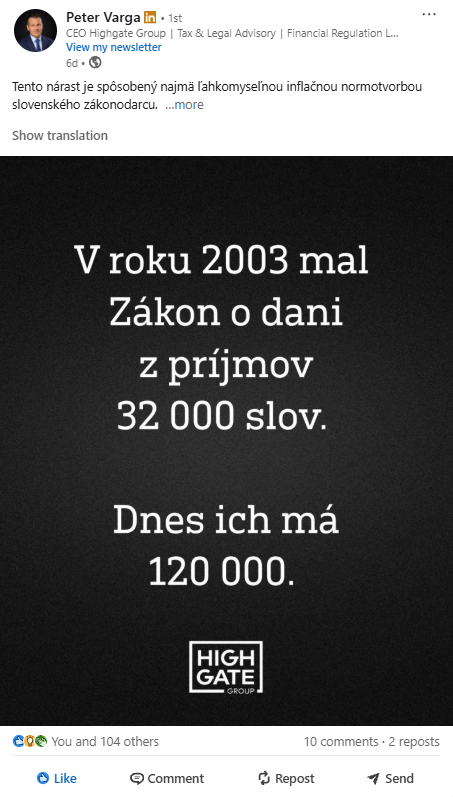
This increase is primarily due to the Slovak legislature’s reckless inflationary policy-making.
The general consequence?
1) more words = higher costs for legal advisors;
2) it fosters apathy or hostility toward the rules (the system), which undermines the rule of law.
What are the specific consequences?
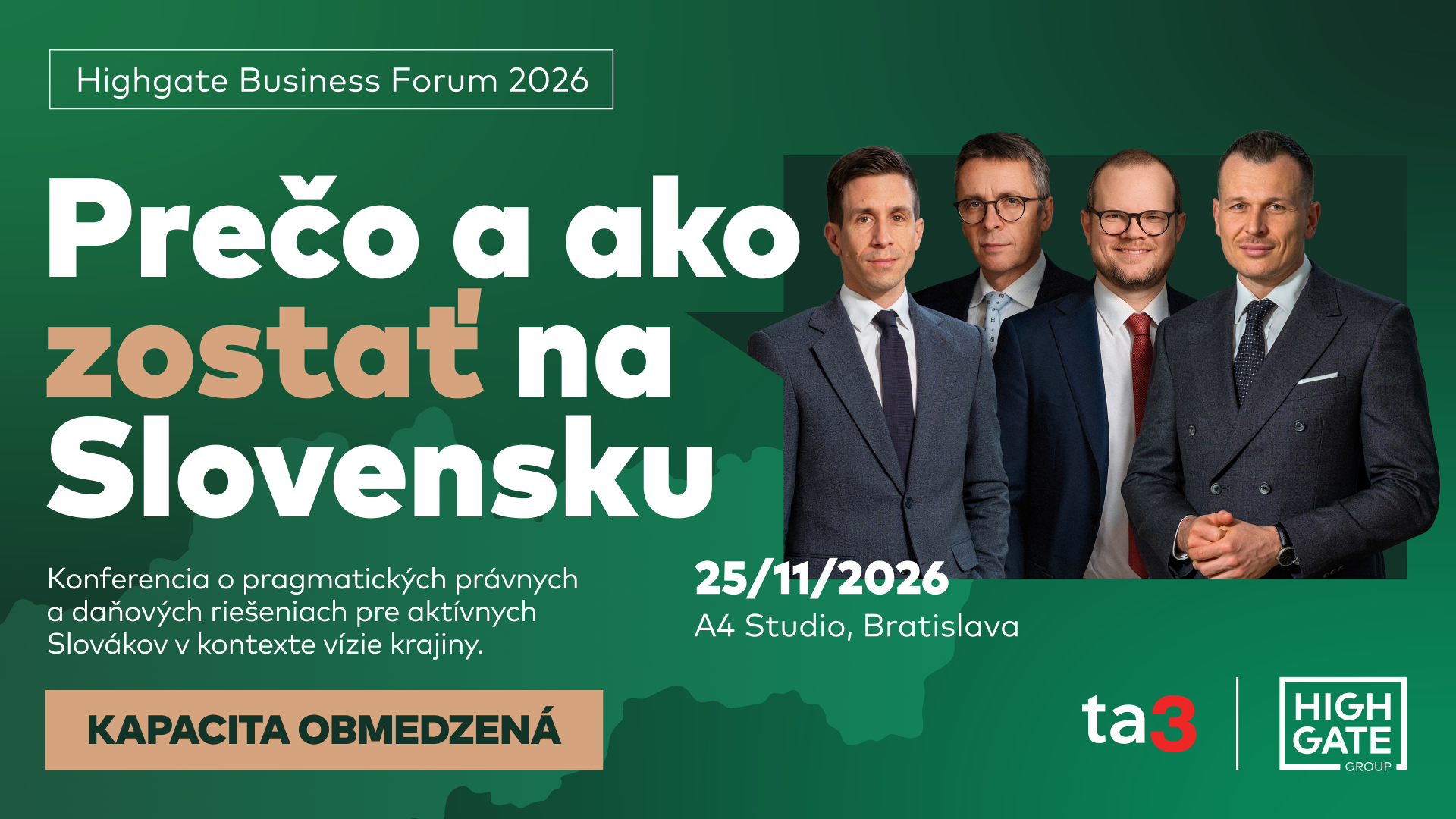
• An entrepreneur has “10 companies” because of the 10% tax (I’ll discuss this in more detail, including the statistics, at our conference “Why and How to Stay in Slovakia?”: https://lnkd.in/d9Szprds);
• Low tax rates on capital gains (for more, listen to the Highgate Group podcast I recorded with Lenka Buchláková on cryptocurrency: https://lnkd.in/dcJ2qnq2);
• Unpredictability—do you already know when the sale of an ETF is tax-exempt? (Check out the Highgate Group podcast I did with Michal Majek on ETFs: https://lnkd.in/dXu4BT7C);
The same applies to VAT. Did you know, for example, that because of the political need to have multiple VAT rates—with a wide range—you can borrow from the government for 20 years at a negative interest rate?
However, when the state creates too many rules and too many exceptions, the stability of the law suffers. And then some rules serve no purpose. And when they serve no purpose, they’re easily circumvented (see the simple and legal way to avoid paying the transaction tax using postal money orders—see the Highgate Group podcast I did with Peter Šebo and Martin Markovic: https://lnkd.in/dtxwkjfr)
Slovakia needs managerial drive that can bring together the diversity of rules into a purposeful public policy. We don’t have that today.
And that is why, with a 50% VAT deduction on a car, we do not need “travel expense reports” for VAT purposes (the government’s right hand wanted to simplify the paperwork), but we do need them for income tax withholding purposes (though the right hand didn’t let the left hand know about this ambition)…
Peter Varga
hashtag tax hashtag legislation hashtag slovakia