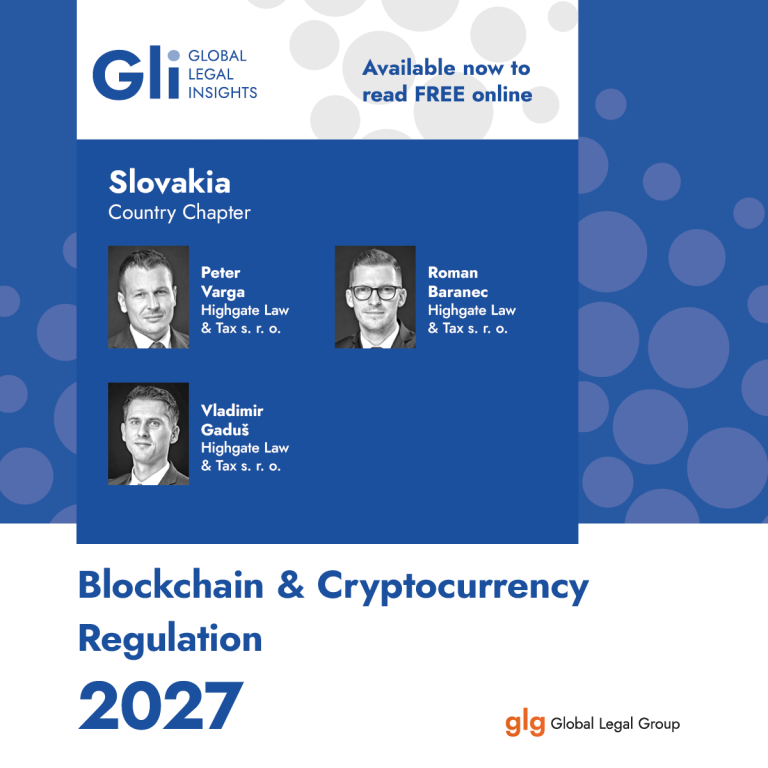
What is the current regulatory environment for doing business with crypto-assets in Slovakia, what factors determine success in obtaining a MiCA license, and what opportunities and risks await crypto-asset service providers? These questions are addressed by our experts Peter Varga and Roman Baranec in the Slovak chapter of the international professional publication *Blockchain & Crypto Assets – Legal Landscapes*, published by the prestigious legal platform The Legal 500.
A chapter dedicated to the legal and regulatory framework for crypto assets in Slovakia was published in the international professional publication *The Legal 500 Country Comparative Guides – Legal Landscapes: Blockchain & Crypto Assets*. Its authors are Peter Varga, a partner at Highgate Group, and Roman Baranec, a senior associate at Highgate Law & Tax, who have long specialized in financial regulation, capital markets, the licensing of crypto-asset service providers (CASP), and related legal and tax issues.
This publication provides an expert perspective on the current state of cryptoasset regulation in various jurisdictions, focusing not only on legislative requirements but also on practical experience, technological developments, and anticipated market opportunities and risks.
The Slovak chapter outlines the fundamental changes that the European MiCA regulation has brought to the cryptoasset market. After the transition period ends on December 30, 2025, the provision of regulated cryptoasset services in Slovakia will be subject to a new licensing regime.
The authors focus primarily on the requirements for obtaining a CASP license from the National Bank of Slovakia (NBS), the rules governing the cross-border provision of services within the European Union, the requirements for a company to have a genuine presence in Slovakia, and the obligations arising from the DORA Regulation.
Special attention is paid to the practical readiness of license applicants. Simply submitting an application is not enough. At the time of submission, the company must demonstrate a viable business model, adequate staffing, sufficient capital, and a ready technological and compliance infrastructure.
The publication also highlights Slovakia’s competitive advantages. One of these may be the relatively easy access to the NBS, including the option of pre-licensing meetings during which applicants can discuss their business models even before submitting their applications.
The publication reflects not only the legislative framework but also our direct experience with licensing proceedings.
At Highgate Group, we represented three of the six companies that had obtained a CASP license from the NBS in Slovakia as of October 16, 2026 . These companies were authorized to provide various types of crypto-asset services under the MiCA Regulation.
In this publication, we also describe our experience with preparing the first-ever application for a CASP license filed in Slovakia. The licensing process took place at a time when not all implementing regulations had been finalized and there was no established supervisory practice by the National Bank of Slovakia (NBS).
Therefore, ongoing communication with the regulator, proper configuration of the business model, and coordination of legal, regulatory, and accounting issues played a significant role.
The publication also includes an overview of technological developments and the future of cryptoasset regulation.
One significant opportunity is the tokenization of traditional financial instruments, particularly bonds and other securities. New regulatory and technological possibilities enable the use of distributed ledger technology (DLT) even within the regulated environment of capital markets.
In this publication, we also highlight our experience advising on the first issuance of tokenized bonds in Slovakia, for which the National Bank of Slovakia (NBS) approved the prospectus in December 2025.
Other topics include the use of artificial intelligence in transaction monitoring, fraud detection, and client communication, as well as the growing importance of technological tools in fulfilling AML and other compliance obligations.
The authors also highlight new regulatory challenges. These include the possible transfer of oversight of certain crypto-asset service providers to the European level, the future expansion of regulation to other crypto business models, and the rising costs of complying with regulatory requirements.
Tax transparency is also a significant issue. The new reporting obligations under the DAC8 Directive impose additional requirements on cryptoasset service providers regarding the collection, processing, and reporting of information on client transactions.
We thus combine our expertise in financial regulation and capital markets with practical experience gained from licensing proceedings, technology projects, and professional publishing at the international level.
You can read the entire chapter of The Legal 500 – Legal Landscapes: Blockchain & Crypto Assets here:
We are the Highgate Group, modern advisors for your law, tax and accounting under one roof.
If you are interested in this topic, please do not hesitate to contact us:
If you are interested, you can subscribe to our newsletter, which features interesting and practical legal and tax information.
You can find more information on legal, tax, and accounting regulations for cryptoassets on our website in the section: Crypto and Legal and Tax Structures.
You can also address your specific questions during a consultation with our partner Peter Varga, who specializes in financial regulation, capital markets, and tax law. You can schedule a consultation here: