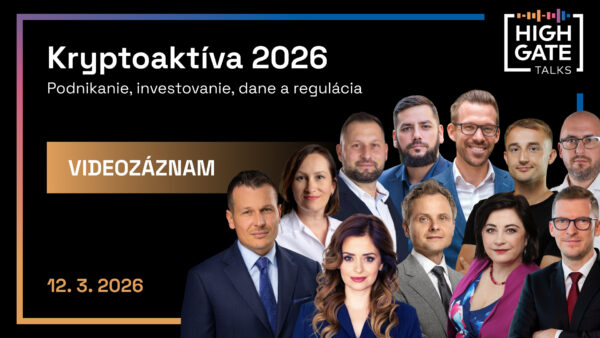
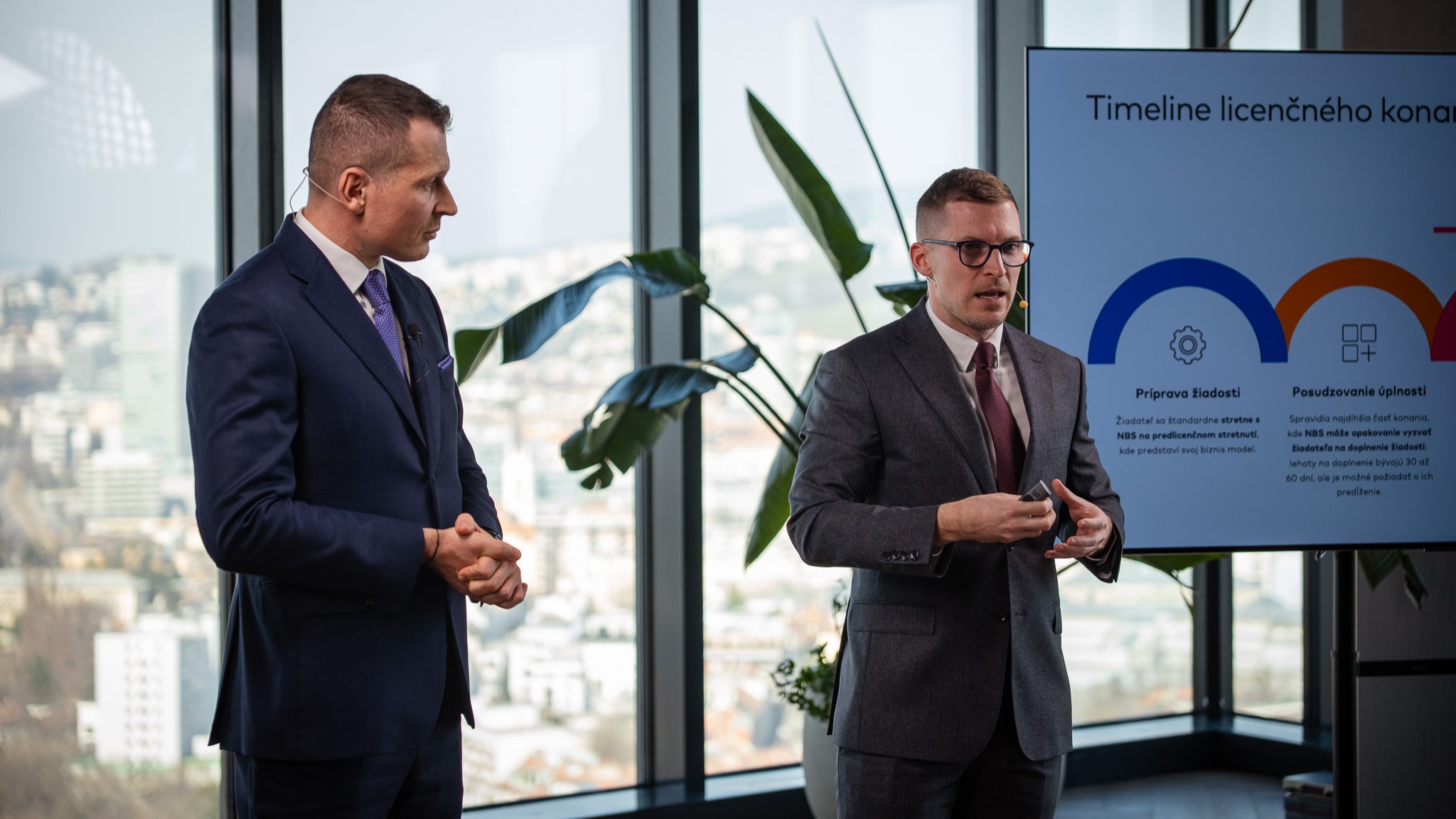
We represent or account for the majority of regulated entities in the field of cryptoassets in Slovakia, we were the first (and so far the last) in Slovakia to implement the tokenization of bonds through a public offering, we have set up several crypto investment funds and we assist clients (including individual investors) in setting up legal and tax frameworks. That’s why we thought it was natural to stand in front of a professional audience and talk in more detail about MiCA’s licensing procedure. The expert lecture by Peter Varga and Roman Baranec covered what it means in practice to obtain a CASP licence in Slovakia today, what documents and settings are required by the National Bank of Slovakia and why it is no longer just “paper” but a completely different league of business.
MiCA has brought to the cryptoasset business what has long been lacking in the European market: a single regulatory framework. Whereas previously individual countries set their own rules, today the provision of cryptoasset services is subject to a harmonised regime across the European Union.
In Slovakia, the previous regulation was extremely simple compared to today. In principle, a trade licence and compliance with AML obligations were sufficient for a certain type of virtual currency business. As a result, there were hundreds of entities operating in the market with varying degrees of real readiness.
MiCA has fundamentally changed this situation. Today, it is no longer enough to “have a company and a business idea”. A cryptoasset service provider must be able to demonstrate capital adequacy, organizational readiness, technical security, risk management, compliance, AML, cybersecurity and, in many cases, real local substance. And that requires extensive effort. An effort that, while not just for large companies, is an effort that even a small company can manage, but must be serious about the business of cryptoassets.
This is precisely why the licensing procedure cannot be seen as a formality. It is a detailed test of whether an entity is capable of operating as a regulated financial institution.
It was mentioned in the discussion that the preparation of the application itself usually takes several months. In practice, it is not just a matter of filling in forms, but of building a complete regulatory infrastructure.
In particular, the National Bank of Slovakia assesses the following areas:
1. ownership and financial structure
The regulator examines who the beneficial owner of the applicant is, what the origin of the resources are, and whether the shareholders or partners are financially strong enough to be able to finance the company even in the start-up phase. In practice, this means a high degree of transparency and “tidiness” of the entire ownership structure.
2. Prudential Requirements
A licensed entity must meet minimum capital requirements while being able to maintain financial health on an ongoing basis. It must already be demonstrated at the time of application that the company has the required funds. For some models, it is also technically challenging to correctly set the accounting and auditing assumptions on which the prudential calculations are based.
3. Personnel and organizational support
A one-person LLC is no longer an option for this type of license. The regulated entity must be realistically staffed with a governing body, compliance, risk management and other control and operational functions. In smaller structures, these roles can be combined, but not to the extent that negates the point of independent control.
4. Technical and process readiness
MiCA can no longer be separated from DORA and cybersecurity issues. If an entity is to provide services with cryptoassets, it must be able to demonstrate how it manages operational and IT risks, incidents, outsourcing or business continuity.
In licensing procedures, it is not enough to know the text of the regulation. You also need to understand how the regulator thinks, where it sees risks and how to translate the individual requirements into a workable business model, documentation and day-to-day operations.
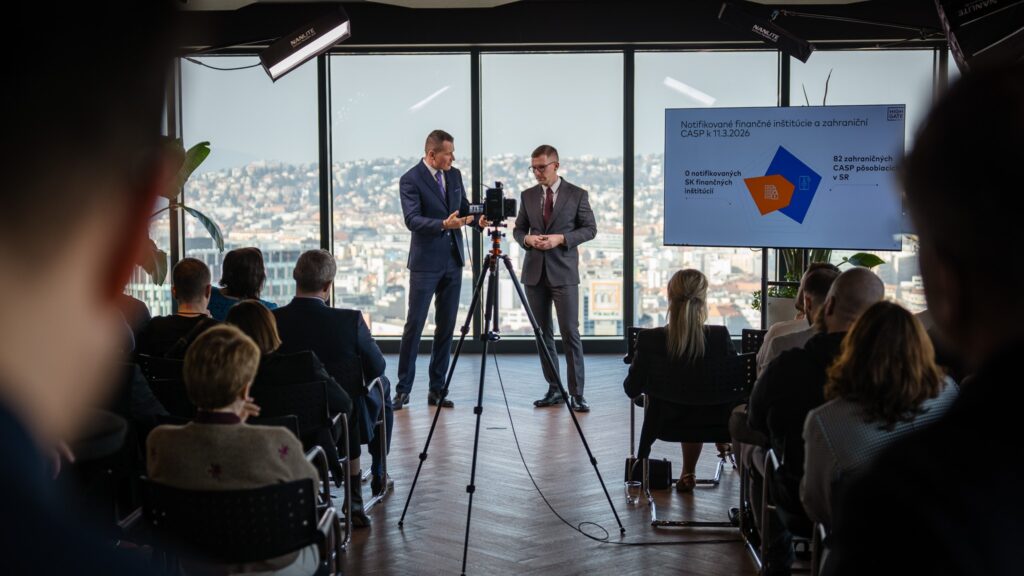
A particular topic of discussion was the issue of substance. Slovakia has become an interesting jurisdiction also for foreign applicants. This has logically put pressure on the licence to be not just a “ticket to the EU” but the result of a real presence and activity in Slovakia.
That is why today more and more emphasis is placed on the entity being able to demonstrate physical premises, local staffing and actual performance of activities from Slovakia. For some foreign founders, this is the moment when they discover that the Slovak licence is not just a legal project, but also an operational decision.
Opening a bank account also remains a practical challenge. Without it, it is difficult to demonstrate compliance with capital requirements, but the banks themselves often wait until the moment when the licence is granted. This creates a classic regulatory paradox: you need the account for the licence, but you need the licence for the account.
It was also clear from the discussion that the licensing procedure in Slovakia still has a very “paper” dimension. The documentation towards the NBS is largely submitted on paper, the submissions have to be in Slovak and even technically modern business often encounters a rather traditional procedural world.
One of the most interesting ideas of the panel was that Slovakia is today an interesting jurisdiction for many foreign players. Not because licensing here is “easy”, but because there is still room for well-prepared applicants who want to build a regulated business within the EU.
This does not mean that it is an easy path. Licensing under MiCA is a complex process that examines shareholders, management, capital, internal rules, IT, security and day-to-day operations. Those who want to succeed today must be prepared not only legally, but also tax, accounting, process and business-wise.
We are the Highgate Group, modern advisers for your law, tax and accounting under one roof.
If you are interested in cryptoasset regulation, MiCA, licensing or wider financial regulatory issues, subscribe to our newsletter for more such news from the business environment.
See the full explanation on MiCA licenses and prepare for the realities of a regulated market HERE.
If you have any questions about MiCA licensing, please do not hesitate to contact us:
For more on the legal, tax and accounting regulation of cryptoassets, please visit the: Crypto and Legal and Tax Structures.
You can also address your specific questions in a consultation with our partner Peter Varga, who specialises in financial regulation and tax law. You can book a consultation here: