

Family-owned businesses make up a significant part of the Slovak economy. However, many of them have long operated primarily on the basis of trust, informal agreements, and long-standing family ties. The very factors that helped them grow in the beginning may, in the future, become a source of conflict, property disputes, or a threat to the entire business. At our Highgate Business Brunch event, Tomáš Demo addressed the most common mistakes he observes in family businesses from the perspectives of law, asset protection, and generational succession.
Many family businesses have operated for decades based on a simple principle: ” We ‘re a family, we’ll figure it out somehow .” In practice, however, trust is often tested most when unexpected events occur: generational change, divorce, inheritance, sibling disputes, or the sale of a business.
In family businesses, the founder’s authority often plays a significant role. Decisions are made informally, without clear rules or processes. This model can work for many years, but as the company grows and more family members join, it becomes increasingly vulnerable.
That is precisely why, in practice, we always recommend that family businesses establish rules for decision-making, ownership, and succession early on, while relationships are still running smoothly.
A large number of Slovak family-owned businesses were established in the 1990s. It is therefore not surprising that a single company today may encompass a manufacturing business, rental properties, real estate development projects, investments, and the owners’ private assets.
Such commingling of assets creates a number of risks:
At Highgate Group, when setting up ownership structures, we often find that many business owners do not begin to address these issues until the moment their company is being sold or a generational transition is taking place. By then, however, there is significantly less room for optimization.
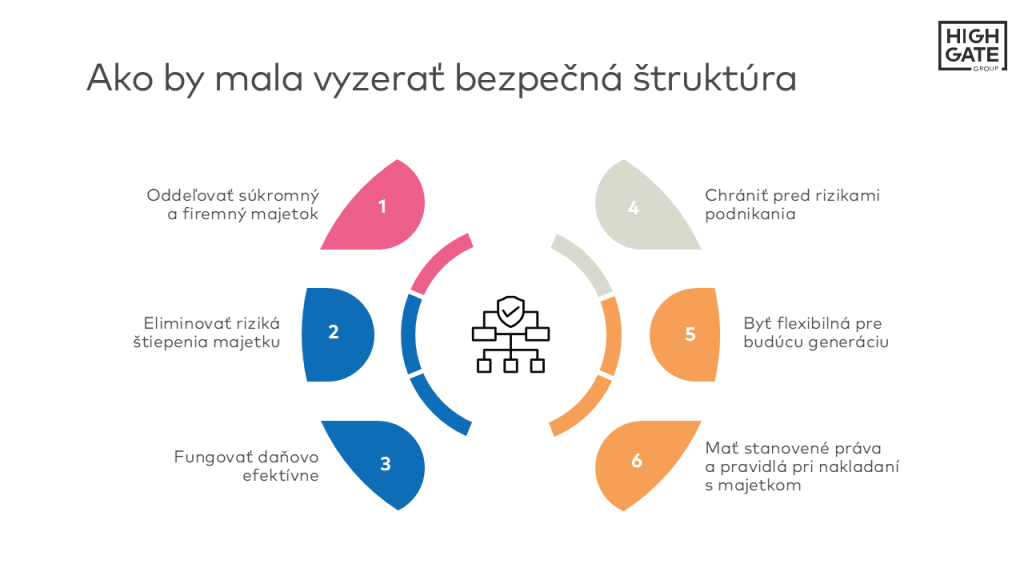
One of the basic tools for protecting the assets of family-owned businesses is a holding company structure. Its purpose is not only tax efficiency, but above all to separate business risks from the family’s private assets.
A properly structured holding company can:
At the same time, however, it is true that a holding company is not merely a formal shell. If it is to deliver the expected legal and tax benefits, it must have real economic substance, engage in its own activities, and fulfill the function of managing a group of companies.
Many conflicts in family businesses do not arise because of a lack of trust among family members. They arise because there are no rules for situations that no one anticipated—or that were anticipated but not considered important enough to address in advance.
A key tool is often a family constitution or similar document that sets out the following principles:
Well-defined rules don’t just protect the company. They also protect family relationships.
Many entrepreneurs spend years building their businesses, but they don’t start thinking about protecting their assets until a problem arises.
However, practical experience shows that a preventive approach yields the best results. Business risk management, proper structuring of ownership, holding companies, family constitutions, and succession planning are among the issues that family businesses should address while they are still in a stable period.
These are precisely the areas we have long focused on at Highgate Group, where we help business families establish structures that protect both their businesses and their assets for future generations.
We are the Highgate Group, modern advisors for your law, tax and accounting under one roof.
If you are interested in this topic, please do not hesitate to contact us:
You can find more information on asset protection (for family businesses) on our website in this section: Asset and Business Protection
If you are interested, you can subscribe to our newsletter for interesting practical legal and tax information.
You can address your specific questions during a consultation with our partner, Tomáš Demo, who specializes in the protection of corporate and private assets—including those of (family-owned) businesses. You can schedule a consultation here: