

Collaboration with sole proprietors, freelancers, and single-member limited liability companies is a common part of doing business today. However, many companies do not realize that it is not the labor inspectorate that poses the greatest threat to entrepreneurs. It is primarily the tax office, which—in addition to the “Švarc system”—can also challenge the claiming of costs as tax-deductible expenses or VAT deductions.
Let’s illustrate this with the example of an IT company that has 10 contractors with a total invoicing amount of 4,000 EUR. Let’s assume that the tax office and the social security agency audit only one year (though it could be more):
| Administrative Authority | Advance Payments | Penalty |
| Labour Inspectorate | – | 4,000 EUR – 200,000 EUR |
| Tax Office | 91,200 EUR | at least 15% per annum |
| Social Insurance Agency | 166,080 EUR | at least 18.5% per annum |
| Health Insurance Company | 76,800 EUR | at least 15% per annum |
In addition, amendments to the Labor Code that change the way dependent employment is assessed took effect on January 1, 2026. Companies can therefore no longer rely on the assumption that a correctly titled contract or a business license automatically constitutes a legal working relationship. What matters most is how the relationship functions in practice.
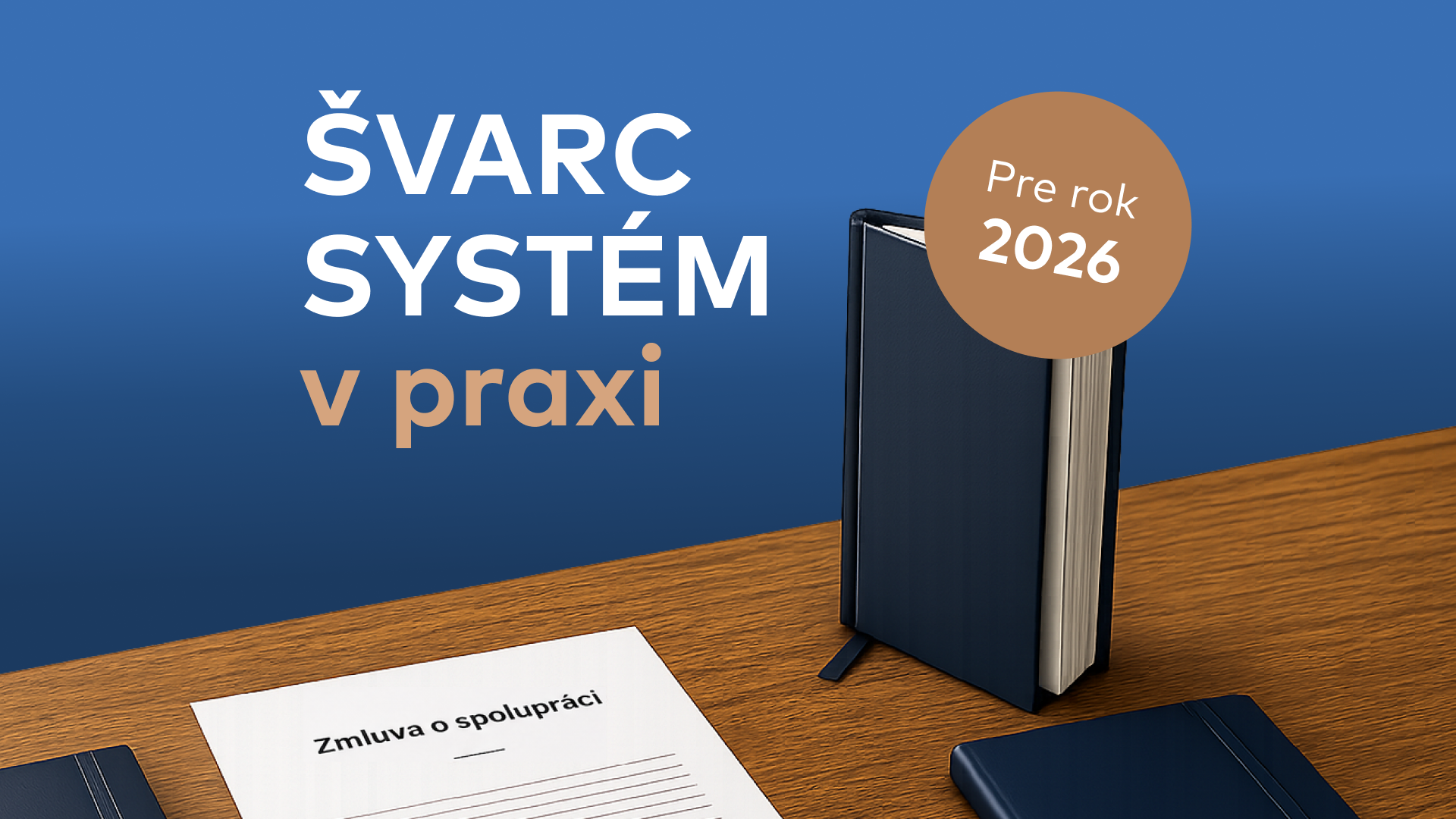
That is why we have prepared a free e-book titled “The Švarc System in Practice,” which provides a practical overview of the rules, risks
, and recommendations for entrepreneurs, managers, and HR departments.
What will you find in the e-book?
✓ An explanation of exactly what the “Švarc system” is and when working with a self-employed individual may be considered illegal employment
✓ New rules effective in 2026, including the four characteristics of dependent employment monitored by the labor inspectorate
✓ Practical answers to questions such as whether a contractor can have a company email address, a supervisor, fixed working hours, or work exclusively for a single client over the long term
✓ Information on the labor inspection process, the questions inspectors most frequently ask, and the penalties companies may face
✓ A Comparison of Tax and Social Security Contributions for Employees, Self-Employed Individuals, and Single-Member Limited Liability Companies, Including the Most Common Myths and Misconceptions
✓ Real-world examples from decision-making practice, a checklist for assessing risks within a company, and recommendations on how to establish safe and legal working relationships with contractors
✓ Peter Varga’s legal argument in favor of entrepreneurs’ freedom of contract.
Download the free e-book and find out if your working relationship with your contractors is set up correctly before the labor inspectorate starts reviewing it.
Just fill out the form below, and we’ll send you the e-book via email.
Law & Tax
Tomas Demo
tomas.demo@highgate.sk
Accounting
Peter Šopinec
peter.sopinec@highgate.sk
Crypto
Peter Varga
peter.varga@highgate.sk