

The regulation of cryptoassets in Europe is moving into a new phase. MiCA brings rules but also new barriers. Getting licensed today is just the beginning – the real challenge comes afterwards. How does the reality work in the Czech Republic and Slovakia, why are banks hesitating and how much does it all cost?
One of the most interesting topics in today’s crypto asset market is the difference between jurisdictions. The Czech Republic has been perceived as a “cryptohub”, which is reflected in the number of license applications – approximately 250.
The result? Only a few licenses granted.
In Slovakia, the number of applications was significantly lower (units to tens), but the resulting number of licences is comparable. This disproportion shows one fundamental thing:
The market has significantly underestimated the difficulty of the licensing process.
In practice, we see that a large proportion of applications were not sufficiently prepared – whether in terms of governance, internal processes or technological infrastructure.
From a business perspective, the key issue is cost.
In a realistic setting, today we are talking about:
And it is the second item that is often underestimated.
Indeed, MiCA is not just a “licence” – it is a comprehensive regulatory regime that includes:
In the Czech Republic, for example, the minimum team is 7-8 people, in Slovakia it is about 4-5.
A very important insight from practice concerns banks.
There is often a narrative that banks “don’t want crypto”. But the reality is much more pragmatic:
The problem is not crypto per se. The problem is compliance.
Banks are among the most regulated institutions in the market. If they enter the crypto world, they face:
From the Bank’s point of view, this creates a fundamental disparity:
This explains why opening accounts for crypto companies is still complicated even though the situation is gradually improving.

A separate topic is the tokenisation of securities.
In the Czech Republic, we see progress – for example, the involvement of the central depository and the emergence of DLT registration. The projects are no longer only theoretical, but also practical.
In Slovakia, the situation is different:
Experience shows that without active government involvement (e.g. digital bond issuance), the ecosystem develops only very slowly.
MiCA is fundamentally changing the market.
Today, it is not whoever wants to get a licence – but whoever is ready.
And by “ready” we mean:
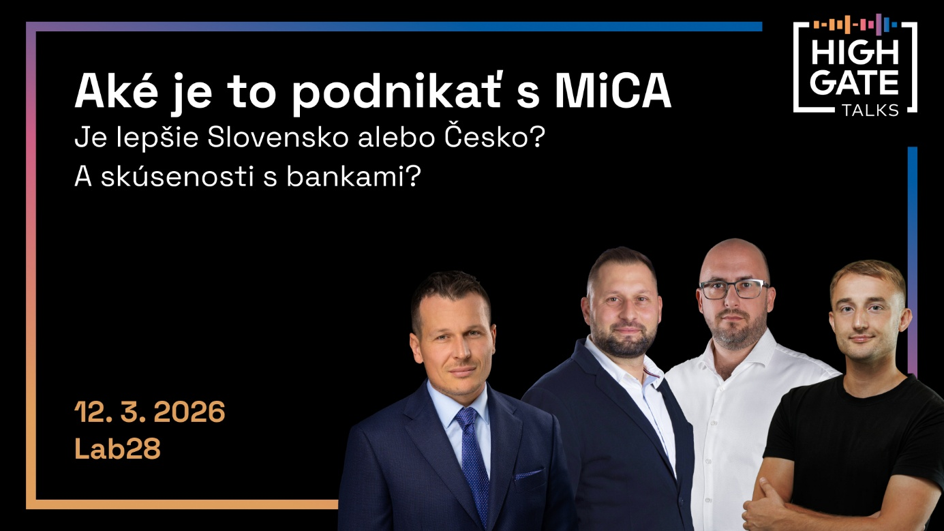
Pozrite si celý záznam panelovej diskusie na tému MiCA, licencovania a reality krypto trhu:
At Highgate Group, we have been working on this topic for a long time – helping clients with setting up regulatory structures, licensing procedures and practical operation after obtaining a license.
If you are interested in this topic, please do not hesitate to contact us:
For more on the legal, tax and accounting regulation of cryptoassets, please visit the Crypto and Legal and Tax Structures section of our website
If you are interested, you can subscribe to our newsletter for interesting practical legal and tax information free of charge.
You can address your specific questions in a consultation with our partner Peter Varga, who specializes in financial regulation (including cryptoassets) and tax law. You can book a consultation here: